LOADING

Vinny · The book
“One second. Counting the house money.”
“One second. Counting the house money.”
Every line is a probability estimate in disguise. Learning to read it changes how you see every number on the board.
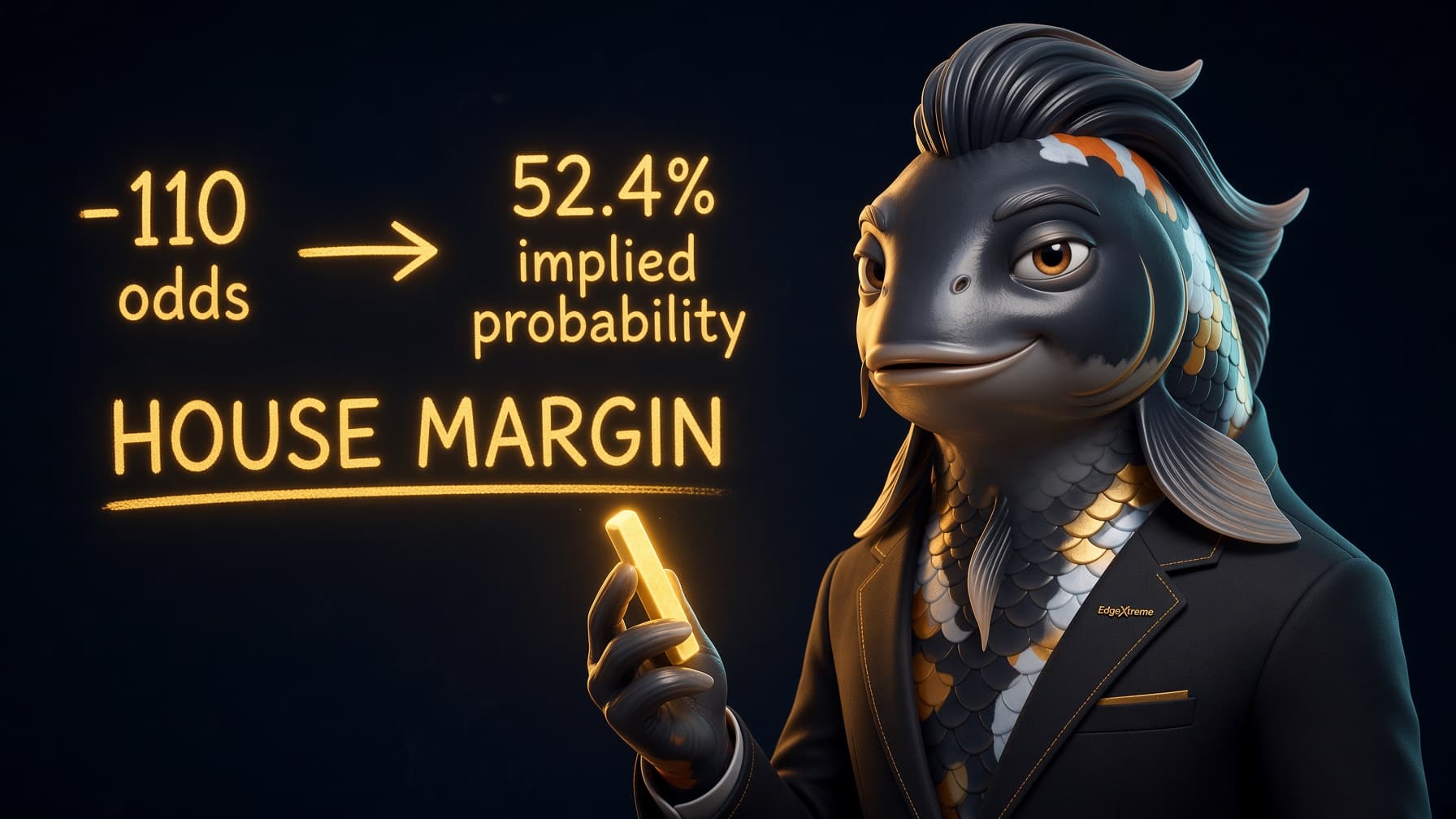
Implied probability is the win percentage baked into a betting line. For favorites it is odds ÷ (odds + 100); for underdogs it is 100 ÷ (odds + 100). A -200 favorite implies 66.7% — the book pricing that team to win two of every three games, plus its vig.
My odds are a language. Most people can't read it, which suits me fine.
When I put up -200 on the Chiefs, I'm saying I think they have about a 66.7% chance of winning. But I've also baked in my vig, so the real implied probability I'm offering is actually a little higher. The two sides of a game add up to more than 100%. That excess? That's my edge. On every game. Every market. Every day.
You're not betting against the other team. You're betting against my number. And my number isn't the truth — it's the truth plus my cut.
I used to look at -200 and think "oh that team's a big favorite, I'll throw some money on them." Never once did I ask: okay but how likely do they actually have to be for this bet to make sense?
Like I'd bet -200 on the Bucks because they were clearly better than whoever they were playing. But even if they win 60% of those games, I lose money at -200. I needed them to win more than 66.7% of the time. I wasn't doing that math. I was just picking teams I liked.
Every American odds line converts to a probability. Here's how:
Negative odds (favorites): -200 → 200 ÷ (200 + 100) = 66.7%. -110 → 110 ÷ (110 + 100) = 52.4%. Positive odds (underdogs): +150 → 100 ÷ (150 + 100) = 40%. +200 → 100 ÷ (200 + 100) = 33.3%.
This is called implied probability — the probability the book is pricing into the line, including their vig. At Edge Extreme, every pick shows the book's implied probability next to our EX probability. The gap between them is the edge. If the book says 45% and we say 52%, that 7% gap is why the bet exists. No gap, no bet.
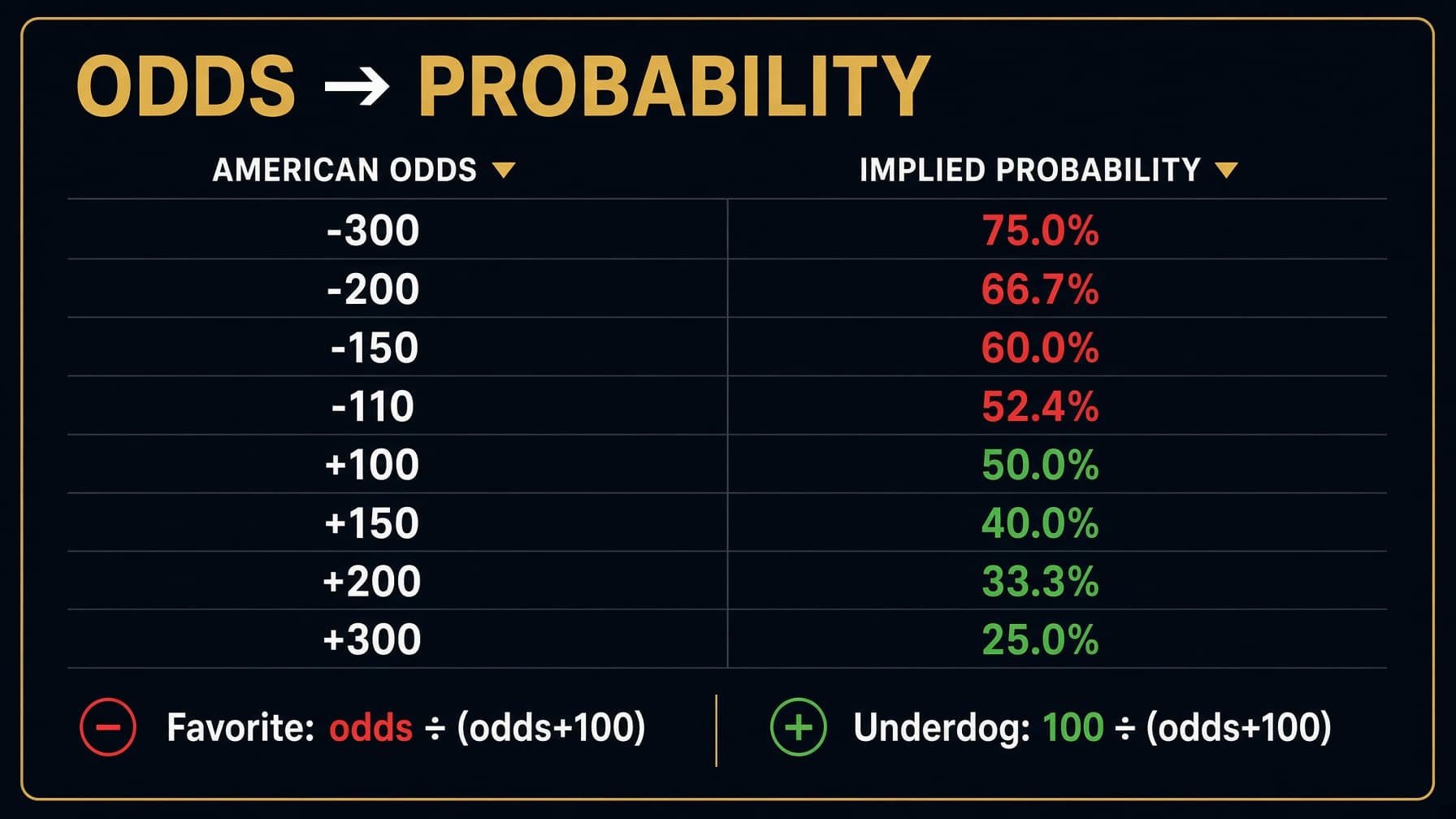
For negative (favorite) odds, divide the odds by (odds + 100): -150 → 150 ÷ 250 = 60%. For positive (underdog) odds, divide 100 by (odds + 100): +150 → 100 ÷ 250 = 40%.
The amount above 100% is the vig, sometimes called the overround. If both sides are priced at 52.4%, they total 104.8% — and that extra 4.8% is the book's built-in margin.
Compare the book's implied probability to your own estimate. If the line implies 45% but you believe the true chance is 52%, that seven-point gap is the entire reason to make the bet.