LOADING

Vinny · The book
“One second. Counting the house money.”
“One second. Counting the house money.”
Every bet has a built-in house fee. It's hidden inside the odds. Vinny loves that you don't see it.
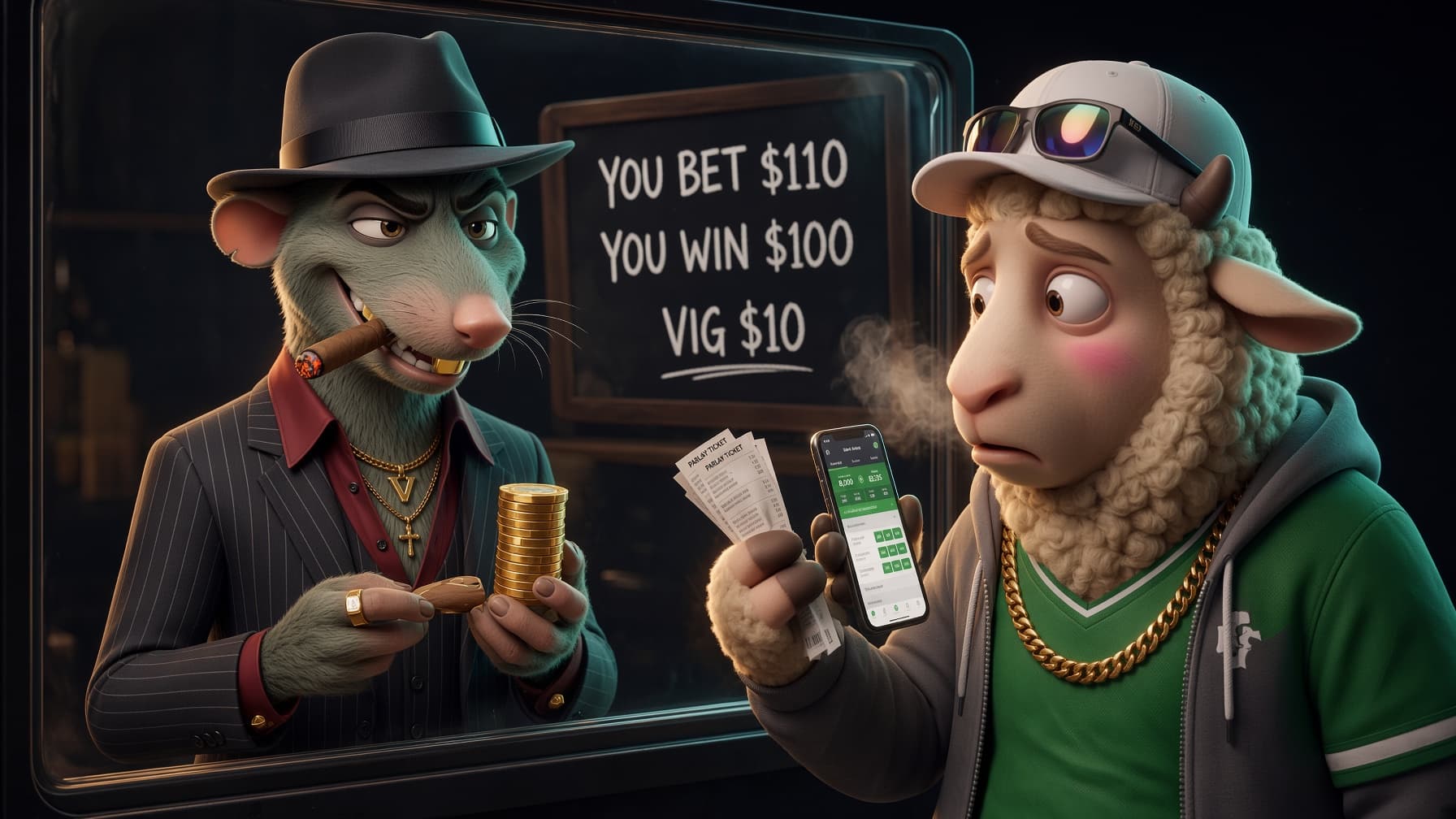
The vig is the sportsbook's built-in commission, hidden inside the odds. At a standard -110 line you risk $110 to win $100, so you must win 52.4% of the time just to break even — that extra 2.4% above a coin flip is the house's cut on every bet, win or lose.
People think I just take bets. I don't just take bets. I charge for taking bets, and I've engineered the whole thing so you never feel the charge.
You want to bet $110 on the Cowboys to win $100? Great. The guy on the other side of your bet puts up $110 to win $100 too. I take $220 total. I pay out $210 to the winner. I keep $10.
That $10 is the vig. The juice. My cut. It's not a fee — it's baked into every single number I put on the board. I don't need to win your bet. I just need to take it.
I bet for two years before someone explained the juice to me. TWO YEARS. I thought -110 just meant the Cowboys were a slight favorite. I had no idea I was paying a tax on every single bet I placed, win or lose.
I did the math once I finally got it. On a normal football Sunday — four bets, all at -110 — I need to win 52.4% just to break even. Not 50%. Fifty-two-point-four. The whole time I thought I was basically a coin flip away from being profitable. I wasn't. I had a hidden 2.4% wall I had to clear before I made a cent.
The vig is the sportsbook's business model, built into every line.
When you see -110 on both sides of a game, it's not even odds. Here's the math: $110 to win $100 means you need to win 52.4% of your bets just to break even (110 ÷ (110 + 100) = 52.4%). A coin flip is 50%. The vig adds 2.4% to your break-even point — and that gap is the book's built-in profit margin on every bet, win or lose.
Some books charge more (-115, -120 on props). Some charge less (-108 on reduced-juice sites). Shopping lines isn't just smart — it's literally recovering money before the game starts. A -110 vs -108 difference on 100 bets over a year adds up to real units. The move: never accept the first number you see.
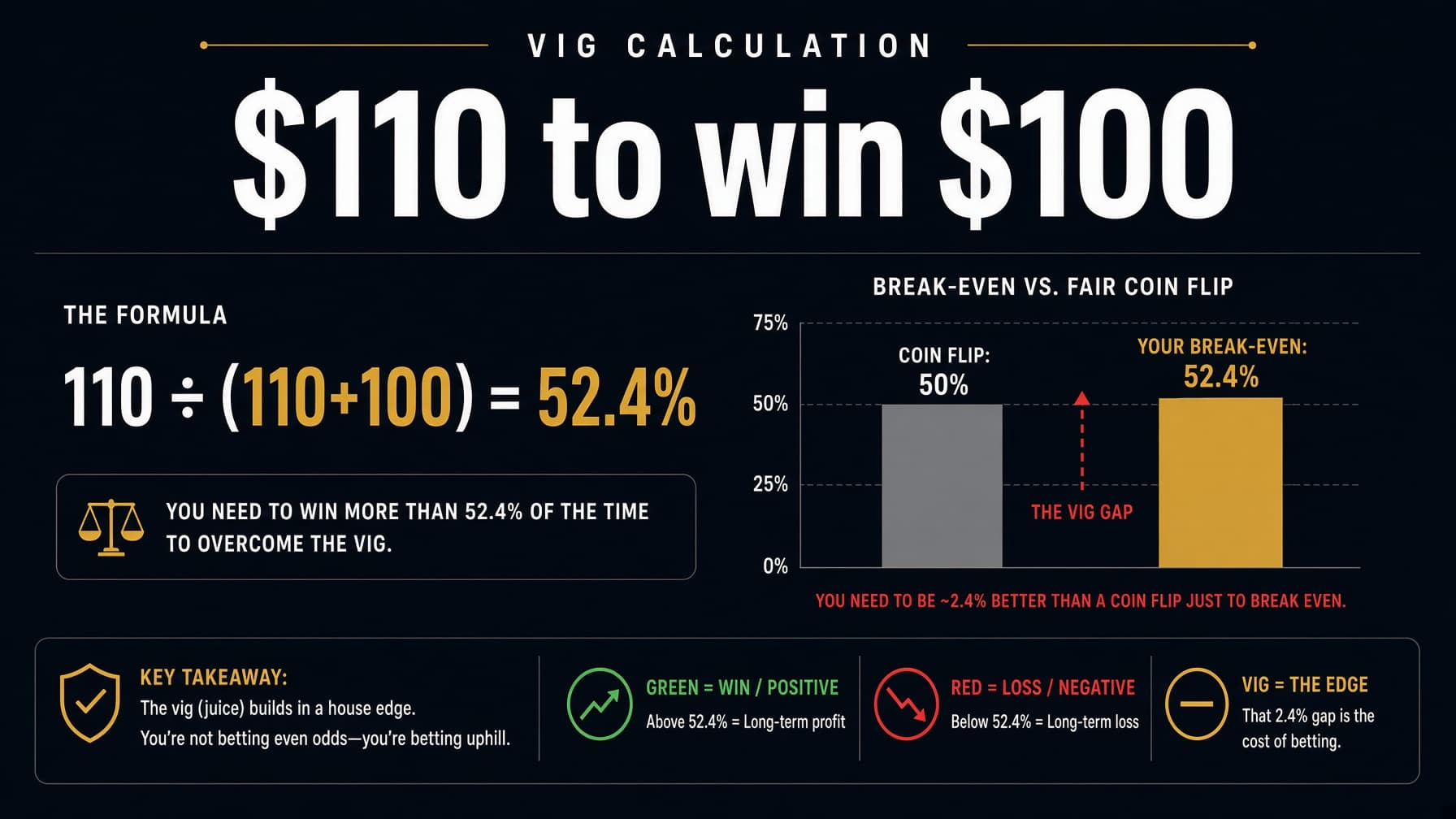
-110 means you risk $110 to win $100. It is the standard price on point spreads and totals, and it bakes in the sportsbook's vig — you need to win 52.4% of these bets just to break even.
On a two-sided -110 market the book collects $110 from each side ($220), pays the winner back $210, and keeps $10 — about a 4.5% hold. The per-bet break-even is 110 ÷ (110 + 100) = 52.4%.
You can't eliminate it, but you can shrink it by line shopping for reduced-juice prices like -105 or -108. Over hundreds of bets, paying less vig is one of the simplest edges available.